
Watch the video

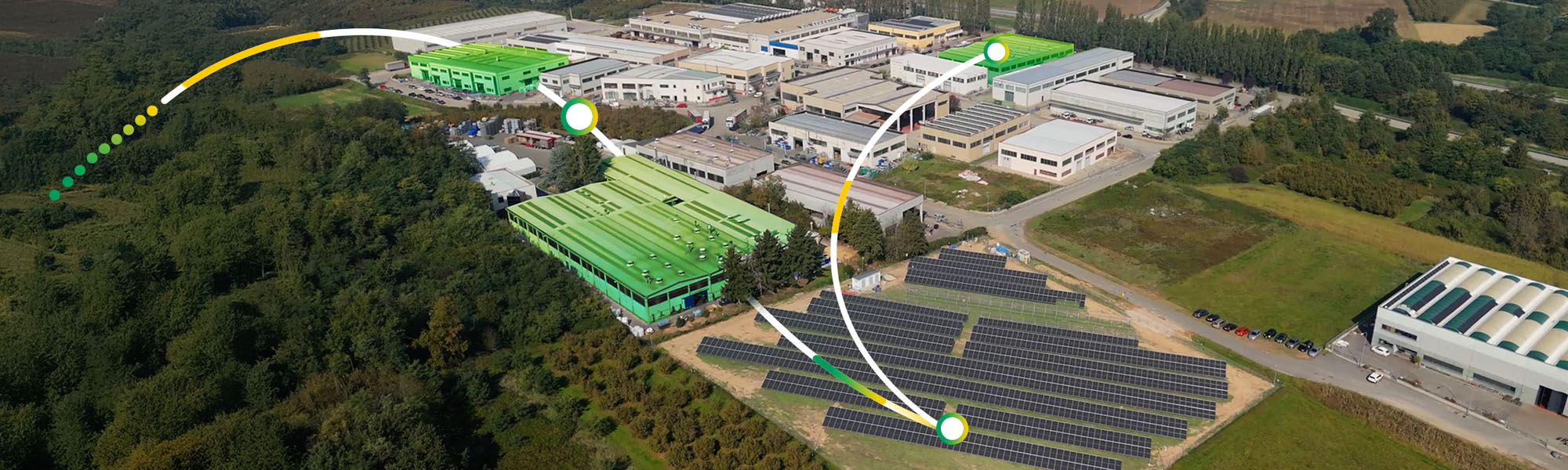
Plenitude’s project for Nuova Simplast and the advantages of virtual sharing to overcome the physical constraints of self-generation.
Turning structural limits into an opportunity for energy efficiency. Starting from this goal, Nuova Simplast, a company specializing in rotational molding of plastics, chose to partner with Plenitude to develop a strategic project capable of fully leveraging the innovative potential of Remote Individual Self-Consumption (AID).
This was made possible through the design of a 758 kWp photovoltaic system, installed in Montà d’Alba (CN) on an industrial plot owned by the company that had previously remained unused. The system virtually shares the energy produced with five supply points located in nearby areas.
Remote Individual Self-Consumption (AID) is one of the incentivized configurations предусмотрed by regulations on Energy Communities, particularly governed by Ministerial Decree 414/23 (the so-called “CACER Decree”). It allows a single entity to produce renewable energy in one location and consume it in another, effectively freeing self-generation from spatial constraints.
The energy is not physically transferred but, thanks to the public grid, can be virtually shared among different properties owned by the same entity. For this sharing to take place, two key conditions must be met: both production points and withdrawal points (PODs, Points of Delivery) must be registered under the same legal entity and be located within the area served by the same primary substation1.
Although the regulation does not exclude private individuals, AID is essentially tailored for the business world, positioning itself as the ideal solution for multi-site companies. These organizations often face a structural mismatch: they may operate energy-intensive facilities with roofs unsuitable for photovoltaic systems (due to space limitations, exposure, or roofing material issues), while at the same time owning large unused areas such as industrial land, parking lots, or logistics warehouses where energy consumption is minimal.
AID addresses this scenario by turning these unused surfaces into strategic assets, enabling the generation of value (energy) that can be virtually transferred exactly where demand exists. For example, a company can install photovoltaic panels on a warehouse roof, parking canopies, or a privately owned solar field, generating energy that—through virtual sharing—covers the consumption of another facility or office building located elsewhere.
Massimiliano Lorenzin, General Manager of Nuova Simplast, explains:
“The added value of this model lies in the ability to turn renewable energy into a shared and strategic asset. Producing energy in a dedicated photovoltaic park and allocating it across multiple withdrawal points allows us to maximize its use, ensuring greater economic efficiency in our industrial processes and an increasingly strong sustainability profile.”
Watch the video
Choosing AID means adopting a solution that combines economic and operational efficiency. Its benefits can be understood by looking at how it works:
Dual value of energy: the investment pays off through two complementary streams. On one hand, the company earns by selling the renewable energy it produces and feeds into the grid, either on the market or through dedicated withdrawal schemes. On the other, it receives a state incentive—guaranteed by the GSE for 20 years—on “shared” energy, meaning energy produced and virtually consumed at the same time.
Reduced bureaucratic complexity: unlike Renewable Energy Communities (CER), AID does not require the creation of a new legal entity or the management of relationships between different parties. The company can operate independently.
Flexibility and scalability: AID is modular by nature. It is not a rigid system: companies can expand their setup over time, increasing plant capacity up to 1 MW per Primary Substation. For companies with multiple locations across the country, the model is replicable—if the same conditions are met (production and withdrawal points under the same substation), multiple AID configurations can be activated across different substations, multiplying benefits nationwide.
Measurable impact: by promoting the use of renewable energy, AID contributes to reducing CO₂ emissions. This is a tangible, measurable figure that can improve a company’s ESG rating and be included in sustainability reporting such as a Sustainability Report.
Beyond these measurable benefits, there is also an increasingly decisive intangible value: reputation. Companies that optimize their assets through AID and invest in renewable energy position themselves as modern organizations that view the energy transition not as an obligation, but as a key driver of competitiveness.
Discover the model that turns energy into a shared resource.
1 A primary substation is an infrastructure within the electricity grid that receives high-voltage energy and transforms it into medium voltage for distribution across a specific area. It also acts as the virtual boundary for AID and, more broadly, for energy communities. All participants must be connected downstream of the same substation, ensuring proximity and enabling local energy sharing.
There’s much more to discover!
From simple users to active players: here’s how prosumers are transforming the energy system through production, sharing, and flexibility.
Prosumer, smart grid and digital energy: towards a flexible energy system
From managing bidirectional flows to integrating renewables, smart grids are the essential infrastructure for energy efficiency, energy communities and smart districts.