Don’t stop here
There’s much more to discover!


Answers to the most common questions, tips, and technologies that help optimize charging times and travel, both at home and on the road.
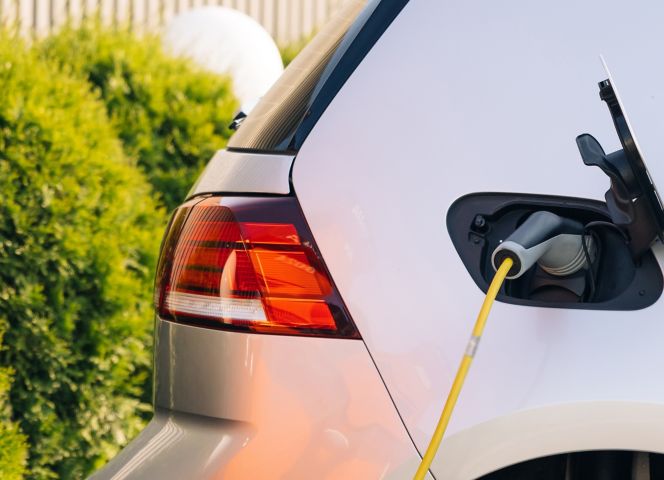
Charging an electric vehicle is the process through which electrical energy is transferred to the vehicle’s battery via charging infrastructure. It takes place in two main ways - alternating current (AC) and direct current (DC) - which differ in terms of speed, power output, and use case: AC charging is ideal for longer stops, such as at home or at the office, while DC charging is designed for rapid top-ups while traveling.
Fast, quiet, and technological: electric mobility is all of this, yet it is often accompanied by a tricky “but.” Charging anxiety can slow down its adoption, even though it is mostly the result of an unfounded fear or of limitations that have now largely been overcome. To clear up any doubts, let’s get to know electric charging better, starting from its technological foundations.
Electric vehicle charging falls into two broad categories depending on the type of current used:
Charging with Alternating Current (AC)
Alternating current charging is the ideal and most widespread solution for medium- or long-duration stops: for example, when parking at a shopping center for an afternoon of shopping or at a sports center for a match with friends. Charging stations of this type, known as “Quick” chargers, deliver a maximum power output of 22 kW.
To ensure the highest levels of safety, these charging stations are equipped with Type 2 sockets, in line with the standards set by European regulations for public charging locations (IEC 61851-1 and 62196-2). This setup makes it possible to charge any electric or hybrid vehicle equipped with a Type 2 plug compliant with the relevant directives.
At public AC charging stations, you will normally need to use the cable supplied with your car, connecting it to the socket on the charging station. What about charging times? They vary depending on the size of your car’s battery, but for an average vehicle connected to a Quick charging station, a full charge generally takes around 3 to 5 hours.
Here is a small practical tip: to avoid technical issues, always remember to disconnect the cable from the charging station first, and only afterward from the vehicle.
Charging with Direct Current (DC)
Direct current charging, on the other hand, is the technology designed for people traveling who need to “fill up” with energy in a very short time. The infrastructure dedicated to this purpose is divided into “Fast” stations, which offer power of up to 150 kW, and “Ultra Fast” stations, which can easily exceed the 150 kW threshold.
To safely manage and transfer these large flows of energy, direct current charging stations provide not only a Type 2 socket, but also connectors based on CHAdeMO and CCS2 standards. CCS2 is currently the most widespread fast-charging connector in Europe for newly registered vehicles.
Unlike AC charging stations, in this case you do not need to take your own cable out of the boot: the cable is already attached to the station, just like the nozzle at a fuel pump. Charging times are significantly shorter: at an Ultra Fast station, many vehicles can recover up to 80% of their range in just 20–30 minutes — the time it takes to have a coffee on the motorway.
No risk of error thanks to the on-board charger (PCS)
Regardless of the power of the charging station selected, there is no risk of making a mistake or damaging the vehicle. Charging is in fact a safe process regulated by the charger installed on board the car — technically known as the PCS — which communicates continuously with the charging station.
In a completely automatic and intelligent way, the vehicle will draw only the amount of energy it is able to manage, protecting the battery and ensuring optimal charging.
Plenitude's road trip itineraries.
One of the distinctive features of electric mobility is expressed in everyday life and, in particular, within the home. Charging at home does not simply mean “plugging in”; it means integrating the car into the overall management of household energy.
Choosing to install a photovoltaic system when using home vehicle charging can help reduce the share of energy drawn from the grid. Some wallbox models are able to communicate with the home system, detecting when solar energy production exceeds household consumption and directing this surplus straight to the car battery.
The potential of this setup increases even further when a storage system is integrated with the photovoltaic system. Storage batteries make it possible to store the electricity produced during the hours of greatest sunlight and reuse it when needed, for example to cover the additional demand generated by overnight charging.
Thanks to the combined use of photovoltaics and storage, the consumption linked to the electric car becomes part of the home’s self-consumption share, thereby reducing the amount of energy drawn from the external electricity grid.
The wallbox
A wallbox is a wall-mounted device compatible with all electric vehicles. It not only optimizes energy use when household loads are lower than the output from solar panels, but also significantly reduces waiting times.
A basic 3.7 kW model completes a charging cycle in around 6–8 hours, a time that can even be halved by choosing higher power levels, such as 7.4 kW or 22 kW, depending on the characteristics of your electrical system.
Using a wallbox also helps overcome one of the most common concerns: the risk of tripping the power when switching on other household appliances. Thanks to dynamic load management, the device detects the home’s electricity consumption in real time and automatically slows down car charging when necessary.
Finally, the “smart” nature of these devices is also a valuable ally for saving money. By using Wi-Fi connectivity and dedicated apps, it becomes possible to monitor consumption statistics and schedule the start of charging sessions according to your needs.
The household socket
Can you charge using ordinary household sockets? European regulatory standards allow connection to the alternating current (AC) grid via domestic power sockets, although specific restrictions or local regulations may apply in some countries.
Direct connection to compliant sockets up to 16A — mode 1 — often used for scooters and micromobility vehicles, is not used for electric cars. For connection to common domestic sockets, such as Schuko sockets, and industrial sockets up to 32A, a cable equipped with an IC-CPD — In-Cable Control and Protection Device — can be used to control the charging process.
However, this cannot be considered an ideal solution either: common domestic sockets, such as Schuko sockets, are not designed to withstand high energy flows for too many consecutive hours.
For everyday use, the wallbox remains the most suitable choice for combining performance and safety.
Resistance to electric mobility often stems from deep-rooted beliefs that are now far removed from reality. The first major concern relates to the availability of charging points: an anxiety that disappears when looking at the real numbers.
Taking an integrated operator such as Plenitude On The Road as a reference, there are now thousands of charging points installed in Italy and across Europe, and the number continues to grow thanks to interoperability agreements. This widespread network makes it possible to travel with peace of mind.
Another widespread belief is that charging takes too long. In reality, the opposite is true: with the right planning, charging is no longer a stop that interrupts the journey, but a process that fits naturally into our habits.
Most charging takes place while the car is parked — at home, at the office, or at a hotel. The energy stop is therefore absorbed into normal daily activities, such as sleeping, working, or shopping.
Distinguishing facts from prejudices is one of the goals of this guide. Understanding the solutions available today is the first step toward no longer being misled by myths and starting to experience electric mobility in an informed way.
There’s much more to discover!
Fully electric vehicles are still a niche in the Italian market. However, the numbers are expected to increase in the coming years. Let's explore the features of e-mobility to understand how we need to change our approach to mobility, both in cities and f
The history of electric cars is truly unique: unlike many other technologies, the path of battery-powered vehicles has been marked by highs and lows and unexpected turns of events. Despite various theories regarding the date of birth of the first electric
When we think of electric mobility, we usually picture cars. In reality, we move through a world powered by silent, versatile wheels.