Don’t stop here
There’s much more to discover!

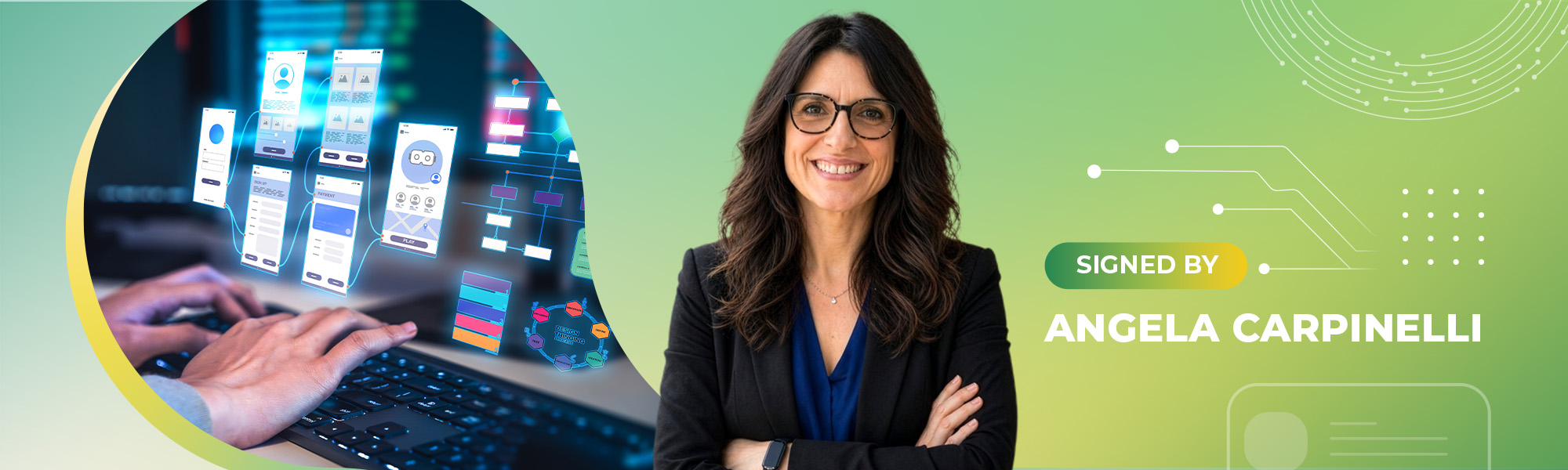
“This is how we combine talent and experience to create tailor-made software.” Angela Carpinelli, Head of Solution Services & Quality Assurance, personally guides us through Plenitude’s new technology hub.
Creating a Software Factory literally means building the intangible. On one hand there is the idea of a lab, a workshop – the “factory” – and on the other that of software, made of code and abstract logic. At Plenitude, we have merged these two worlds to create a concrete and solid asset: a place where innovation is not only designed but also “manufactured” to become lasting value for the entire company.
Let’s imagine it as a family recipe, the result of care and insights passed down through generations. I think of the Pastiera made in my home: it is not just a dessert, it is a set of skills developed internally and handed down over time. A living knowledge that has been able to face a constantly changing reality without ever losing its identity. Over the years, ingredients, tastes, and tools have changed. From the rolling pin to AI, the Pastiera has evolved precisely because it is rooted in skills that have become part of the family heritage.
The first step was building the team. To do this, we opened the doors to those willing to get involved, and the response was enthusiastic. Our “Factory Builders” are software engineers enhanced by AI. By leveraging their expertise, enriched by experience in solution design, and training them in the use of Artificial Intelligence, they have become specialists capable of “talking” to machines to translate business needs into technology more quickly and with higher quality.
The Software Factory is like a kitchen where different roles work together toward a single outcome, driven by the desire to transform: a verb that for us means changing, but also creating value starting from what already exists.
All colleagues applied voluntarily and then followed tailored training to master both the technical languages of our integrations and AI-based generative coding tools.
Returning to our culinary metaphor, two elements are needed to make this new hub work: the right tools and an overall vision. The Solution Designer is the one who holds this vision: like an expert chef, they know the ingredients, master the recipe, and have a clear understanding of the final result. It is a key role that designs the solution in its entirety from start to finish. Their task is to align business needs with technical company standards, ensuring that the software created is consistent and, above all, easy to use and manage in everyday practice.
Supporting operational work are agents. In this way, AI becomes a true virtual colleague based on advanced models, assisting us in all development phases: from coding to documentation, through to release and deployment. It understands context, suggests optimizations, and frees people from repetitive tasks.
If we were in a kitchen, we could think of it as a modern food processor: while it mixes and cooks, the chef focuses on creativity.
The Factory is a young reality, born in July 2025, which took its first steps with a challenging pilot project: the development of the integration component on Azure cloud technology, within an already planned migration. It was our testing ground: the first real proof to make what we had learned tangible and build the foundation for future projects. The group is now gradually growing to complete the internalization of development activities by summer 2026.
There is one final essential step: automated testing first at the level of individual factory development, and then centralized within the broader Quality Assurance (QA) process. Our systems simulate real scenarios to identify potential defects, while the QA team ensures that every piece of software meets the highest standards of reliability and compliance with initial requirements. Returning to our Pastiera, this is the decisive tasting moment. After carefully measuring every ingredient and working the dough, we must ensure all components are in balance before serving it.
And it is precisely at this stage that the true value of the journey emerges. The Software Factory marks the shift from “industrial” development – the classic standardized outsourcing – to “bespoke” development. We no longer simply adapt pre-packaged solutions, but shape applications around Plenitude’s real needs. The benefits are tangible: we reduce development times, improve code quality, and increase team retention because feeling like the creator of solutions generates a strong sense of belonging.
The deeper goal is the internalization of skills: to stop being mere buyers of technology and become its creators, building a “technical memory” that remains within the company and makes us increasingly independent and resilient to market challenges.
Unique and inimitable, just like a family Pastiera.
There’s much more to discover!
Cloud, AI and automation at the core of Plenitude's digital transformation to improve efficiency and customer experience.
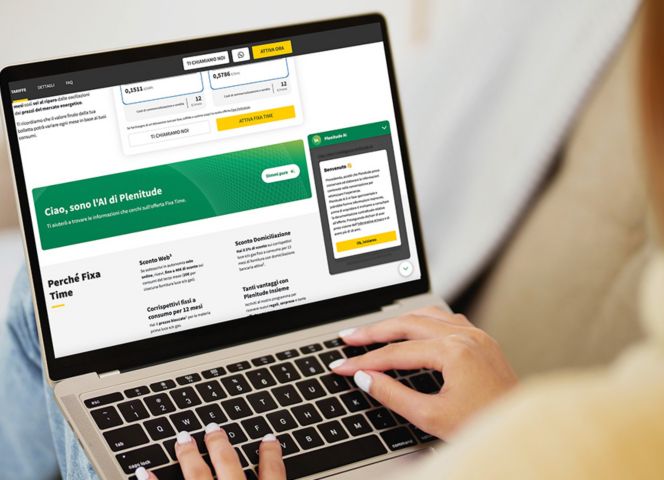
Introducing the new Plenitude chatbot, which uses artificial intelligence to engage with the customers of today and the ones of tomorrow.
From Turing’s theory to translating reality into data: how AI has entered our everyday lives and the energy sector.