Don’t stop here
There’s much more to discover!


Not just technology, but tactical vision: we explore with Maria Angela Bracale, our first “Energy Shaper,” the work of a Project Engineering Manager—balancing speed, precision, and integration.
The energy transition is not only about technology, but also about people who are able to tackle increasingly complex challenges. Alongside more familiar roles such as designers, installers or energy managers, new professional figures have emerged — just as essential, yet often unexpected for those outside the sector. Their role? To actively “shape” the energy system, making it more flexible, stable and efficient through their skills and expertise. We have called them “energy shapers” for their ability to transform the sector through a unique blend of diverse competencies.
But how do you tell the story of such complex roles? Often, a title or a simple description is not enough. To capture the true essence of these professionals, we decided to take inspiration from a well-known tool: the Proust Questionnaire. Originally conceived as a parlour game in 19th-century salons to reveal people’s true nature through direct and introspective questions, here we use it to explore the human side of technology. We won’t use the original version, but a reinterpreted edition designed to reveal not a personality, but the soul of a profession through three key questions.
Our first “energy shaper” is Maria Angela Bracale, Project Engineering Manager, one of the professionals at Plenitude helping to design the future of energy storage systems.
The past two years have been frenetic for the growth of renewables and the demand for storage. What image best captures this period?
“Off the top of my head, a race car. It perfectly symbolises how fast we’ve been moving over the last two years. We had to put together a series of highly complex pieces in a very short time to reach a crucial milestone: winning Terna’s MACSE auction. What does that mean? Simply put, it’s the mechanism that ensures there is always a reserve of energy available to prevent blackouts and keep the grid fully covered. It was a real race of speed and precision that allowed us to authorise and launch projects that are crucial for the security of Italy’s power grid.”
What is the key word to understand the current energy storage landscape?
“Evolution. BESS — large-scale electrochemical energy storage systems — are growing exponentially. Technologies are changing, markets are evolving and stakeholder interest is increasing. It’s a constantly evolving context, and we expect it to continue transforming radically over the coming years.”
Among the many activities you carry out, what is the fundamental action that defines your role?
“Integration. My job is to connect those who develop the plant with those who physically build it, managing procurement and construction sites. In the past, the focus was on bringing together the technical team with Business Development and Permitting to obtain authorisations. Now that we have reached the project execution phase, integration extends to Execution as well. Without this continuous connection between the different professionals involved and across functions, results simply cannot be achieved.”
An Energy Shaper’s profile goes beyond technical skills alone: it requires a holistic vision and the ability to anticipate future scenarios. To complete the picture and make these complex dynamics more tangible, we decided to end each interview with an exercise in synthesis: finding an analogy that captures the strategic essence of the job. For Maria Angela, managing storage systems in an evolving market requires the same tactical clarity as a game of chess.
“It’s an exercise in vision and anticipation, where every move must be carefully calculated. On the board there are several pieces. There are solar and wind power: powerful pieces, but ones that can only move under certain conditions, such as sunlight or wind. And then there is the BESS, the wildcard piece: it doesn’t produce energy, but it can store it and redistribute it at any time,” Maria Angela explains. “The key move is hybridisation — connecting the intermittent pieces to the wildcard. This tactic ensures that no opportunity is ever lost: excess energy production is not discarded (a phenomenon known as curtailment), but stored for a later move (peak shaving).”
The rules for winning, however, are changing rapidly. “In the past, victory mainly depended on using the ‘special abilities’ of the wildcard piece (the BESS): intervening quickly to stabilise the grid when it was under stress. Today, the strategy is more complex and is based on two main moves: the first is energy trading, understanding the perfect moment to release stored energy onto the market; the second is participation in long-term agreements, which guarantee steady points over time.”
The player’s true skill therefore lies in anticipating how the rules will evolve, because the real challenge in this game is not only producing more renewable energy, but managing it intelligently. And here, the player’s imagination and expertise can truly make the difference.
Just as the famous questionnaire invites us to look beyond appearances, our journey to discover the faces of the energy transition does not stop here. With this series, we will continue to explore the essence of the professions that shape energy. We will soon meet other “energy shapers”, with new questions and new answers, to keep exploring this evolving world — one skill at a time.
There’s much more to discover!
What’s the spark that drives us to give our best every day? This question opened the first dialogue of the Plenitude Cultural Hubs, Plenitude’s internal initiative designed to put people and the values that unite them at the centre.
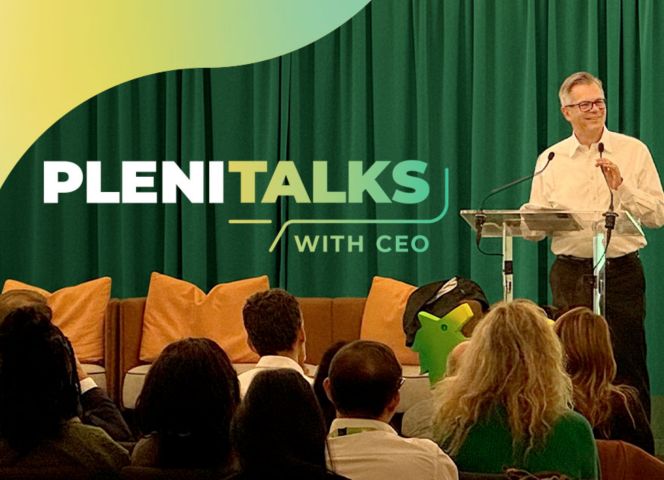
Listening and sharing are at the heart of the PleniTalks journey, which has taken our CEO, Stefano Goberti, to offices around the world. A journey that began three years ago and is still ongoing.
Eni Plenitude S.p.A. Benefit Corporation has achieved gender equality certification according to UNI Reference Practice PdR 125:2022, a tool designed to encourage Italian companies to adopt concrete measures to bridge the gender gap. 2154. This is the year when, according to the Global Gender Gap Report 2023 published by the World Economic Forum...