Solar Energy: Plenitude’s Projects, Technology, and History

From solar farms to self-consumption: harnessing the power of the sun with Plenitude.

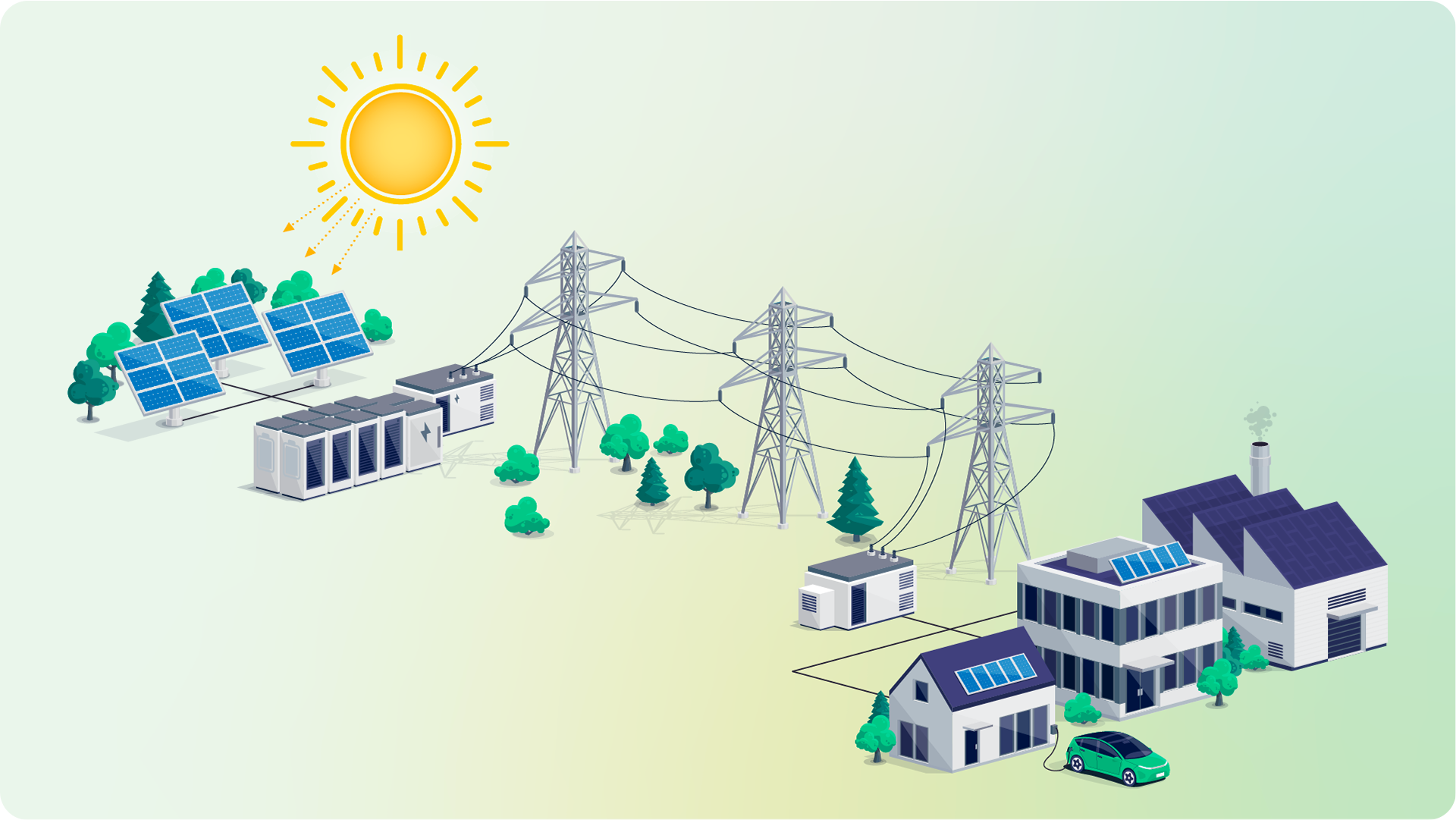
Solar energy plays a central role in the ongoing energy transition. Transforming sunlight into renewable energy follows two key paths, both at the heart of Plenitude’s business model. On one hand, there is the development and operation of utility-scale solar farms designed to generate renewable electricity and feed it into the grid, while also creating value for local communities and revitalizing unused industrial areas. On the other hand, there is the growing adoption of advanced self-consumption solutions, providing households, residential communities, and businesses with the tools needed to produce part of their own energy.

Plenitude’s Commitment to Photovoltaics

Solar parks, photovoltaic parks, solar power plants, or solar farms. Different names for the same concept: utility-scale facilities that generate electricity for distribution through the power grid. These installations cover vast areas, often located in rural or industrial regions with high solar irradiation. Notable examples include Plenitude’s major international projects, from the Renopool plant in Spain, which with a capacity of 330 MW is the largest solar park ever built by the company, to the 50 MW plant in Zhanaozen, Kazakhstan, integrated into a hybrid facility combining solar, wind, and gas generation.

impianti fotovoltaici

A photovoltaic park is the result of careful planning that considers not only solar irradiation potential but also land characteristics and integration with existing local activities. It consists of thousands of solar panels connected to high-capacity centralized inverters. Panels may be fixed or equipped with trackers that rotate according to the sun’s position, as seen in the La Flota plant (Murcia, Spain), which features bifacial modules with solar tracking technology. The electricity generated is fed into the national grid through substations that increase voltage levels, enabling faster and more efficient distribution.

Turning Sunlight into Electricity: Discover How

From a single rooftop panel to large-scale projects across Europe and beyond, explore the many ways solar rays are transformed into energy with Mariangiola Mollicone, Head of Western Europe Renewables and Managing Director of Plenitude Renewables Spain.

How Photovoltaics Work

But how does this transformation happen from a technical perspective? Whether installed in a solar farm or on a residential rooftop, photovoltaics rely on technology that converts solar energy into electricity through solar panels. These panels are made up of photovoltaic cells that, when exposed to sunlight, trigger the photovoltaic effect and generate direct current (DC). The electricity is then transferred to an inverter, which converts it into alternating current (AC) for consumption, grid injection, or storage in batteries. These energy flows are tracked through a bidirectional meter and managed by a monitoring system. The panels themselves make a significant difference in the process, varying in materials and performance. The vast majority are based on silicon technology, with n-type monocrystalline silicon currently standing out for its excellent balance between efficiency and long-term durability. Looking ahead, perovskite technology offers the promise of even higher performance, and research efforts are focused on ensuring the stability required for large-scale deployment. This technological evolution aims to improve energy yield while enabling greater integration between solar installations and the surrounding environment.

Photovoltaics and Local Communities

Agriculture and Solar Energy

Agrivoltaics is the term used to describe solar parks installed on agricultural land in ways that allow farming and energy production to coexist. Panels are mounted at elevated heights to reduce interference with agricultural activities, or they may provide beneficial shade for certain crops. They can also be equipped with sensors that monitor soil and crop conditions, helping optimize irrigation and fertilization. In Villarino de los Aires, in the province of Salamanca, Spain, Plenitude has developed a photovoltaic plant with an installed capacity of 220 MW. Covering approximately 286 hectares, it is among the largest facilities in the Castilla y León region.

Integrating Solar Energy with Local Heritage

An interesting example of how energy infrastructure can coexist with local heritage comes from Spain, where the development of renewable energy projects is combined with attention to historical and cultural preservation. During construction of the Caparacena solar park (150 MW), preventive site monitoring activities led to the discovery and safeguarding of an Iberian necropolis dating back to the 6th century BC, containing ancient ceramic funerary urns. The site was managed in close collaboration with local authorities to protect the archaeological remains uncovered, following an approach that was also successfully applied at the Renopool project. There, Plenitude catalogued and preserved archaeological findings discovered during construction, making them available for future research initiatives.

Photovoltaics for the Regeneration of Brownfield Sites

Solar parks can also help revitalize decommissioned industrial areas, turning them into valuable resources for local economies. For example, Plenitude carried out the remediation of an 11-hectare site in Ravenna Ponticelle (owned by Eni), where the permanent safety measures required by the remediation plan included the installation of an impermeable capping layer.

More than 10,000 solar panels were subsequently installed on the site, achieving a total capacity of 6 MW. The bifacial monocrystalline silicon modules generate electricity from both the front and rear sides and are mounted on dedicated solar tracking structures. These structures are secured using ballast systems placed directly on the capping layer, fully integrating with the site's environmental recovery project.

Photovoltaics and Self-Consumption

Alongside utility-scale photovoltaics, designed to produce electricity for grid injection, another rapidly growing model focuses on self-consumption. These smaller-scale systems are used to meet part of the energy needs of manufacturing facilities or, more commonly, households. Most self-consumption systems are intended for residential use and can easily be seen on rooftops or within the immediate vicinity of homes. They are sized according to the user’s energy requirements. These systems can be combined with smart energy management technologies that optimize consumption patterns based on electricity production. In addition, integrating battery storage systems makes it possible to store surplus energy generated during the day and use it later in the evening or whenever the photovoltaic system is not producing electricity. This further increases self-consumption rates.

Who Are Prosumers?

Discover our profile of the new protagonists of the energy landscape.

Discover more

Energy Communities

Energy communities represent a collaborative model of energy production and consumption based on shared resources and cooperation. From a technical perspective, they can be described as virtual networks connecting multiple generation and consumption units. Both public and private entities can participate, benefiting from the system. Owners of photovoltaic systems can not only generate energy for their own use but also share surplus electricity with other community members and receive financial incentives in return. Italian legislation now groups the various forms of locally produced and shared renewable energy under the acronym CACER (Collective Self-Consumption Configurations for Renewable Energy Sharing).

How Does an Energy Community Work?

Discover the different CACER models, participant roles, and benefits for citizens and businesses.

Discover more

The Future of Solar Energy

From Edmond Becquerel’s discovery of the photovoltaic effect in 1839 to the present day, the history of solar energy has been marked by continuous and rapid progress, transforming the results of scientific research into one of the pillars of the modern energy transition. The electrification of energy consumption is a defining feature of this transition and requires a diversified energy mix in which photovoltaics play an increasingly important role. Its scalability and suitability for both utility-scale and residential applications make it one of the most versatile technologies available. Its adoption is further encouraged by the increasingly proactive role consumers play in energy production and consumption. The growing digitalization of energy systems enables users to monitor and control electricity generation and usage directly, promoting energy efficiency and self-consumption.

In this context, artificial intelligence opens up new possibilities through innovative services and technologies that can support even more efficient energy use, optimizing load distribution and demand management. Consider smart battery storage systems that use predictive algorithms to learn from consumption habits and weather forecasts, storing energy at optimal times and releasing it when demand is highest. AI can also help make power grids smarter, more efficient, and increasingly automated, facilitating the integration of multiple energy sources and enabling energy exchange among prosumers through larger and more sophisticated virtual energy communities.

The future of solar energy is therefore emerging as a deeply interconnected and digitalized ecosystem, where production, distribution, and consumption are seamlessly integrated and intelligently managed through a vast network of devices and algorithms working in continuous coordination.

Discover the other technologies

  • Energy storage: Plenitude’s projects, technology and history 

    From residential batteries to utility-scale storage: energy storage capacity and its role in the energy transition. 

  • Wind energy: Plenitude’s projects, technology and history 

    Onshore and offshore wind farms: the contribution of wind power to the energy transition.