Energy storage: Plenitude’s projects, technology and history

From residential batteries to utility-scale storage: energy storage capacity and its role in the energy transition.

Energy storage systems make it possible to store energy produced from renewable sources and make it available exactly when needed. Plenitude actively contributes to this evolution through two strategic areas: on the one hand, it offers advanced storage solutions integrated with photovoltaic systems to maximize self-consumption for households and businesses; on the other, it develops and operates large utility-scale storage facilities. These large infrastructures, directly connected to the electricity grid, are designed to work in perfect synergy with the wind and solar farms they are associated with, or to operate independently. They provide regulation and stabilization services, offering flexibility in dispatch management and continuously balancing the grid to respond to energy demand in real time. Understanding how these technologies work means looking at the progress of the entire sector, from home batteries to large international storage systems.

Plenitude’s commitment to large-scale storage

In Sardinia, Plenitude developed its first utility-scale storage facility in Italy. Located in Assemini, near Cagliari, it has been operational since June 2023, within the same industrial area that also hosts a 23 MW photovoltaic plant, with which it shares some connection infrastructure.

The Assemini facility was built using battery modules based on Lithium Iron Phosphate (LFP) technology and is one of the first utility-scale storage systems connected to Italy’s National Transmission Grid. The facility provides the “fast reserve” service for ultra-fast frequency regulation, with the aim of improving grid frequency stability, in coordination with existing services. In addition to contributing to the security of the electricity system thanks to very fast activation times, this represents a key step in enabling an increasing share of renewable energy in Italy’s energy mix.

impianti storage

Plenitude’s position in the storage sector is not limited to Italy: this facility is complemented by the Guajillo storage facility in Texas. The facility is located next to one of Plenitude’s largest operational solar farms, Corazon Solar Farm, to maximize operational synergies. It will provide local electricity grid stabilization services, thereby contributing to the efficiency of the energy system across the region.

Electricity can be stored: discover how

Energy storage systems are becoming a crucial asset in the energy transition. In this podcast, Marco Scurati, together with guest Marco Congiatu from the Pipeline Development team, takes us on a journey to discover how electricity produced from renewable sources is stored and transformed into energy for change.

Storage: how it works

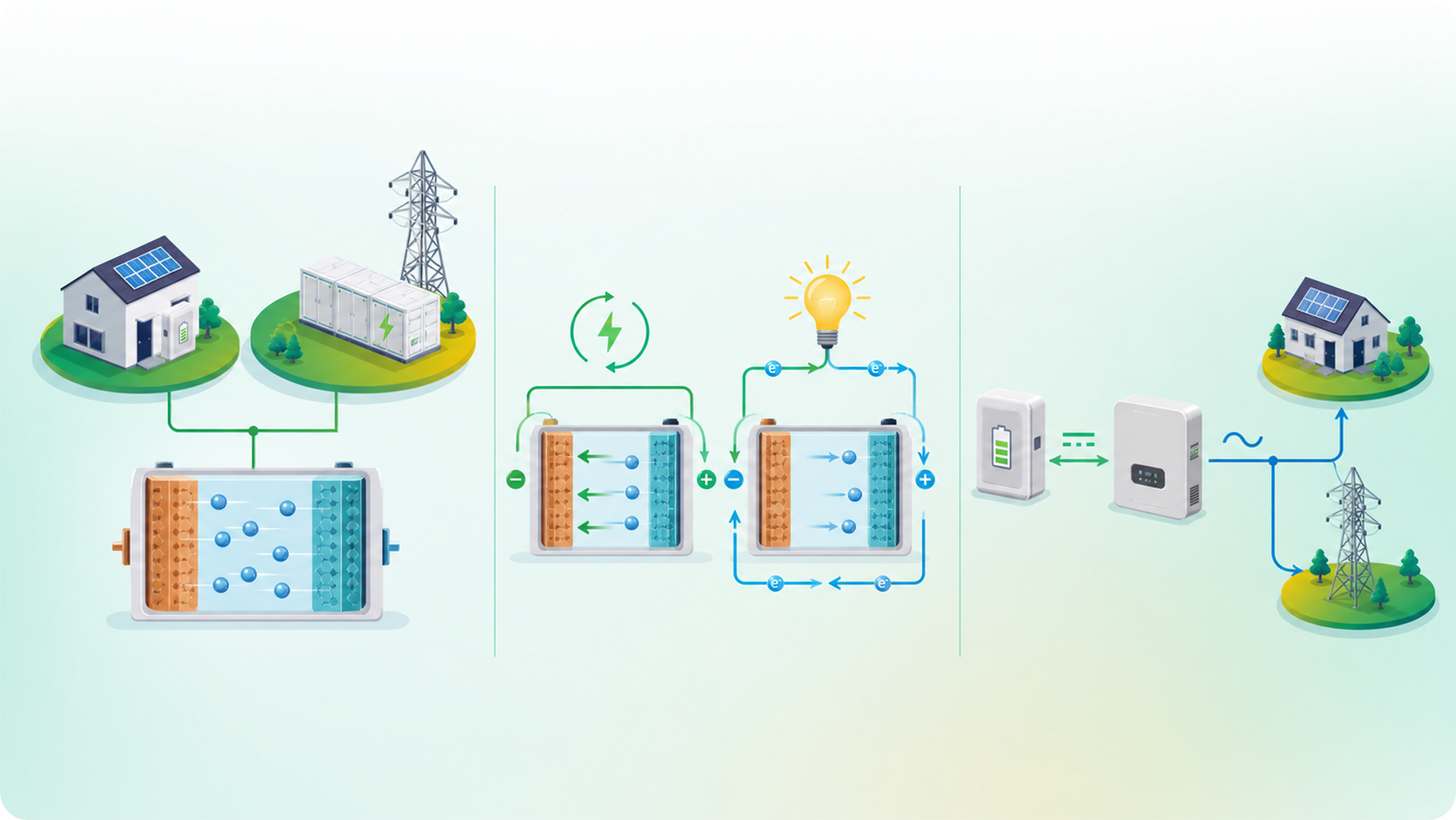
Whether it is a home battery or a large utility-scale facility, the principle behind lithium-ion storage systems is the same and is electrochemical in nature. A battery consists of two electrodes, an anode and a cathode, immersed in a conductive medium called an electrolyte. During charging, lithium ions migrate from the cathode to the anode, where they are stored in the form of chemical energy. During discharge, the process is reversed: the ions move back towards the cathode inside the battery, while electrons flow through the external circuit, generating a direct electric current.This remains the dominant technology in the storage sector thanks to its ability to withstand a very high number of charge and discharge cycles. Over the past decade, alternative solutions such as flow batteries have also been developed. These use liquid electrolytes to store energy and are characterized by a long lifespan and good scalability, particularly for utility-scale applications. Before it can power household loads or be fed into the grid, the direct current stored in batteries must be converted into alternating current by an inverter. This is an essential step both in residential systems and in large-scale facilities, where inverters can reach power levels in the megawatt range.

Residential storage and self-consumption

Storage also plays a fundamental role in optimizing self-consumption at the residential level. Batteries are generally connected to the photovoltaic system and sized according to its generation capacity. They make it possible to store excess energy produced during hours of solar irradiation, making it available during periods without direct production, such as the evening and nighttime hours.

The integration of the photovoltaic system, battery and inverter is essential to maximize self-consumption. The inverter not only converts the direct current produced by the panels into alternating current that can be used at home, but can also manage the flow of energy to the storage system and the electricity grid based on production, consumption and the battery’s state of charge.

Storage for grid stability and flexibility

The widespread adoption of renewable sources, such as solar and wind power, which are intermittent and non-dispatchable by nature, makes storage an essential element for ensuring grid stability and reliable energy supply. Storage facilities, particularly utility-scale systems, help balance potential mismatches between supply and demand by providing frequency and voltage regulation services.

Through the time-shifting mechanism, these systems optimize the use of energy: they absorb excess production during periods of low demand (overgeneration) and release it during peak periods.

Storage also plays a strategic role in absorbing additional electricity demand. In this context, the concept of energy flexibility refers to the ability to adapt production and consumption to system signals. Thanks to the integration of storage systems, the user evolves from prosumer to prosumager, a profile capable of managing its own energy flows to support the grid when needed.

In an integrated ecosystem, distributed storage systems can be grouped together to operate in synergy as a Virtual Power Plant (VPP). This configuration makes it possible to provide flexibility services with very fast activation times, contributing to the security of the electricity system. The result is a more efficient consumption model, in which large-scale storage and residential batteries work together to make citizens and businesses active participants in the energy system.

Energy flexibility: what it is and how it works

Explore the mechanisms and benefits of this new paradigm.

Find out more
Target raggiunti e prospettive future

The history: from the battery to storage

The desire to store energy and make it available exactly when it is needed has accompanied human development for a long time. While for millennia people were forced to consume resources at the very moment they were produced, the real turning point came with the study of electricity. At the turn of the eighteenth and nineteenth centuries, the idea of using electrochemical reactions to generate and store an electric current forever changed our relationship with energy, triggering a technological evolution that continues today with modern storage systems.

1799

Invention of the voltaic pile by Alessandro Volta.

This device, consisting of copper and zinc discs separated by cloths soaked in a saline solution, was the first to generate a constant flow of electricity. Since then, research into energy storage has made enormous strides, leading to the development of various technologies, including lead-acid batteries, still used today to start internal combustion engines, and nickel-cadmium batteries.

1970 – 1980

Development of lithium-ion batteries.

Thanks to their high energy density, low weight and long lifespan, these batteries quickly conquered the consumer electronics market, powering devices such as laptops, smartphones and tablets. They remain the dominant technology in the storage sector thanks to their high ability to withstand a very large number of charge and discharge cycles.

2019

Nobel Prize in Chemistry awarded to John B. Goodenough, M. Stanley Whittingham and Akira Yoshino. They are considered the leading figures behind the development of this technology.

2024

Use of flow batteries in the storage system connected to Plenitude’s Ponticelle photovoltaic plant in Ravenna.

The increasingly deep integration of storage systems confirms that the development of renewable energy sources goes hand in hand with the ability to store their energy. Thanks to advanced technologies and aggregation models such as Virtual Power Plants, storage helps bridge the gap between the intermittent nature of these resources and the grid’s need for flexibility and dispatchability. This is why supporting the growth of storage capacity means investing in a model of progress capable of generating long-term value for the entire electricity ecosystem.

Discover the other technologies

  • Solar Energy: Plenitude’s Projects, Technology, and History 

    From solar farms to self-consumption: harnessing the power of the sun with Plenitude.

  • Wind energy: Plenitude’s projects, technology and history 

    Onshore and offshore wind farms: the contribution of wind power to the energy transition.