Don’t stop here
There’s much more to discover!

Here’s how Goodnight Light, Plenitude’s new project, helps children welcome their fears and learn to care for them.
Every evening, in countless homes, there is a moment that brings families together. At bedtime, a hand reaches toward the switch, but the gesture pauses in front of a request every parent knows well: “Can you leave the light on?”
Fear of the dark is a delicate phase that affects almost all children, placing adults at a crossroads: should they give in to the request to reassure them, or turn off the light to help them learn to face their fears? Almost always, reassurance wins. And it’s no coincidence: light has proven to be a much more manageable source of comfort than the classic stuffed toy. It stays in one place, is always available, and can easily be replicated in different settings. This practicality has even encouraged many parents to favor it over other forms of comfort.
This is where an idea comes in—made of stories, friendship, and pure wonder. It is the heart of Goodnight Light, created precisely for this purpose: to transform darkness into an embrace. No longer an empty space that causes fear, but an enchanted and safe world waiting to be explored.
To better understand the dynamics of fear associated with darkness, we commissioned Doxa to conduct a quantitative survey (CAWI methodology) in Italy, France, and Spain on a representative sample of parents with children aged 3 to 9. In November 2025, the study involved 1,002 respondents in Italy alone, where the results confirm how widespread this emotion is, experienced by more than three out of four children. It is a natural part of growing up.
However, there is something new when it comes to Generation Alpha—those born from 2010 onward: today, light has overtaken the classic stuffed toy as the primary source of comfort. This very need for security leads 80% of families to leave a light on throughout the night, even though they are aware that this choice is not the most energy-efficient.
Is there a way to make children feel safe without necessarily leaving the light on? A suggestion comes from Dr. Elena Urso, a pedagogy expert specializing in family relationships, who analyzed the survey results. The most common mistake, she explains, is trying to deny fear with logic.
“Telling someone—especially a child—not to be afraid is a paradoxical injunction that creates confusion,” explains Dr. Urso. “Fear is an ancestral emotion that ensured our survival. It must be welcomed, not judged. Only by acknowledging a child’s emotion and managing it together with their parents can we provide the tools to keep it from overwhelming them.”
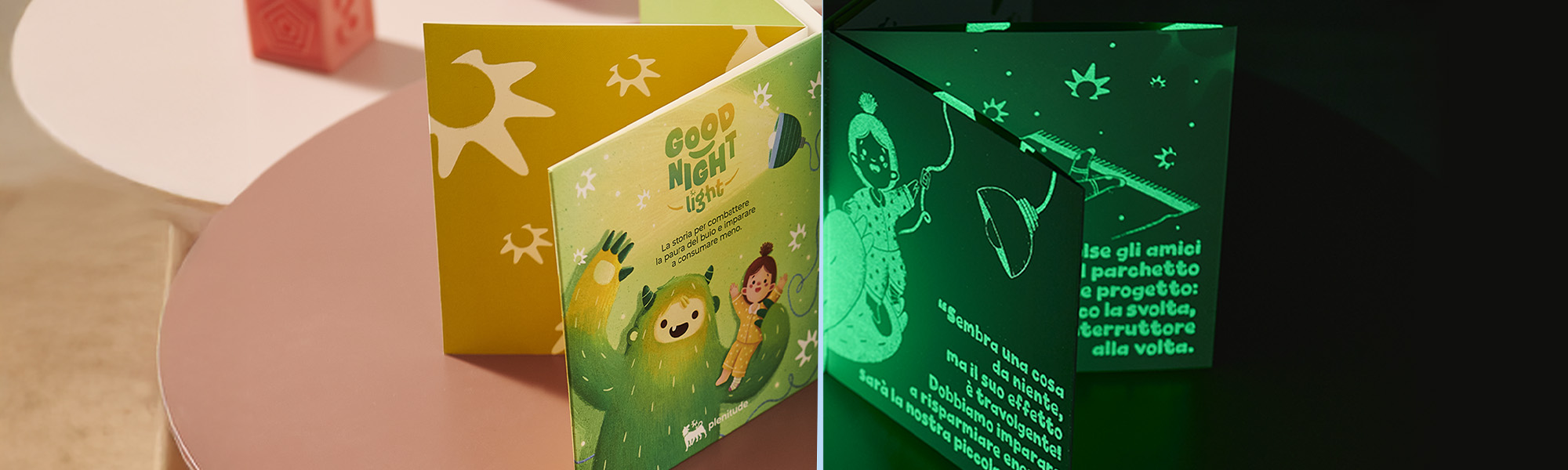
This very shift in perspective did not lead to the usual light bulb turning on, but instead to a book. A special object capable of capturing light and releasing it when needed. Written by Elisa Binda and Mattia Perego and illustrated by Sara Villa, Goodnight Light uses a special photoluminescent ink that becomes visible only in the dark: the pages, white in a lit environment, reveal words and drawings only when the switch is turned off.
The book thus becomes a “Night-Light Companion”: a tool that releases the light it absorbed during the day. It doesn’t consume electricity but reassures children in many ways, starting with the reading of a story.
At the center of the story is Ombro, a character who overturns expectations and rehabilitates the dark. He lives in the shadows, but he is not a monster—he is a friendly companion who suffers from too much light.
This shift in storytelling is the key to encouraging energy awareness without imposing rules that young children often struggle to understand.
“A sense of duty is not innate in children, but empathy is,” the psychologist emphasizes. “Asking a child to turn off the light to take care of their friend Ombro is far more effective than an abstract rule. The child feels responsible and willingly collaborates.”
The project also works on children’s autonomy. Unlike a night light that remains fixed in a socket, the book requires physical interaction. The child opens it, flips through it, and in doing so “activates” the magic.
“Moving from a passive to an active role is a crucial psychological step,” continues Dr. Urso. “By turning the pages, the child experiences firsthand that they have the resources to go through and overcome fear. A simple gesture that helps build strong inner confidence.”
But there is more. At a delicate moment such as bedtime, Goodnight Light helps establish a routine made of slow, predictable gestures—essential for falling asleep peacefully.
“At this stage of the day, children need low stimulation: stepping away from bright lights and screens is fundamental,” she explains. “That’s why the tactile dimension of the book is so valuable: touch is the primordial sense through which children experience the world. Repeating this simple gesture brings them back to a state of calm, turning the book into a familiar ally.”
To immerse families in the world of Goodnight Light, Plenitude has created a multilingual virtual room. By visiting the dedicated landing page on eniplenitude.com/goodnightlight, the characters Lucilla and Ombro will guide parents and children in discovering the project.
The digital experience allows visitors to explore the survey results in depth, discover valuable “golden rules” and tips for bedtime, and learn how and where to receive a complimentary copy of the book.
The campaign launches on March 10 across digital and social channels in Italy, France, and Spain. But the Goodnight Light journey will also come to life in the physical world: over the weekend of March 20 and 21, special distributions of the book will take place at participating Plenitude flagship stores, as well as during family-focused events in Paris and Santander.
An invitation, then, to rediscover a slow and precious ritual—turning pages together. A way to guide families toward more conscious habits and children toward a discovery filled with wonder: sometimes, to see the most beautiful things, all it takes is the courage to turn off the light.
There’s much more to discover!
New light for the Piedmont village “without sun”: restoring the historic mirror brings sunlight back to the community.
Not just technology, but tactical vision: we explore with Maria Angela Bracale, our first “Energy Shaper,” the work of a Project Engineering Manager—balancing speed, precision, and integration.
From photons striking a sensor to the illusion of cinematic motion: a journey through light as it becomes art.