
All the project milestones

The Burlington Energy Project (Project) is a proposed solar photovoltaic and battery energy storage project in Kit Carson County, Colorado. The project would combine solar power generation with battery energy storage to generate electricity from solar energy and store electricity for later delivery to the grid, subject to final design and grid conditions. The facility is planned on approximately 1,083 acres of private land near Burlington, Colorado.
As the Project moves forward, Plenitude will work with local agencies, landowners, and community members as we complete the Project design, resource studies and required federal, state, and local permitting. Community input is an important part of the design and permitting process.
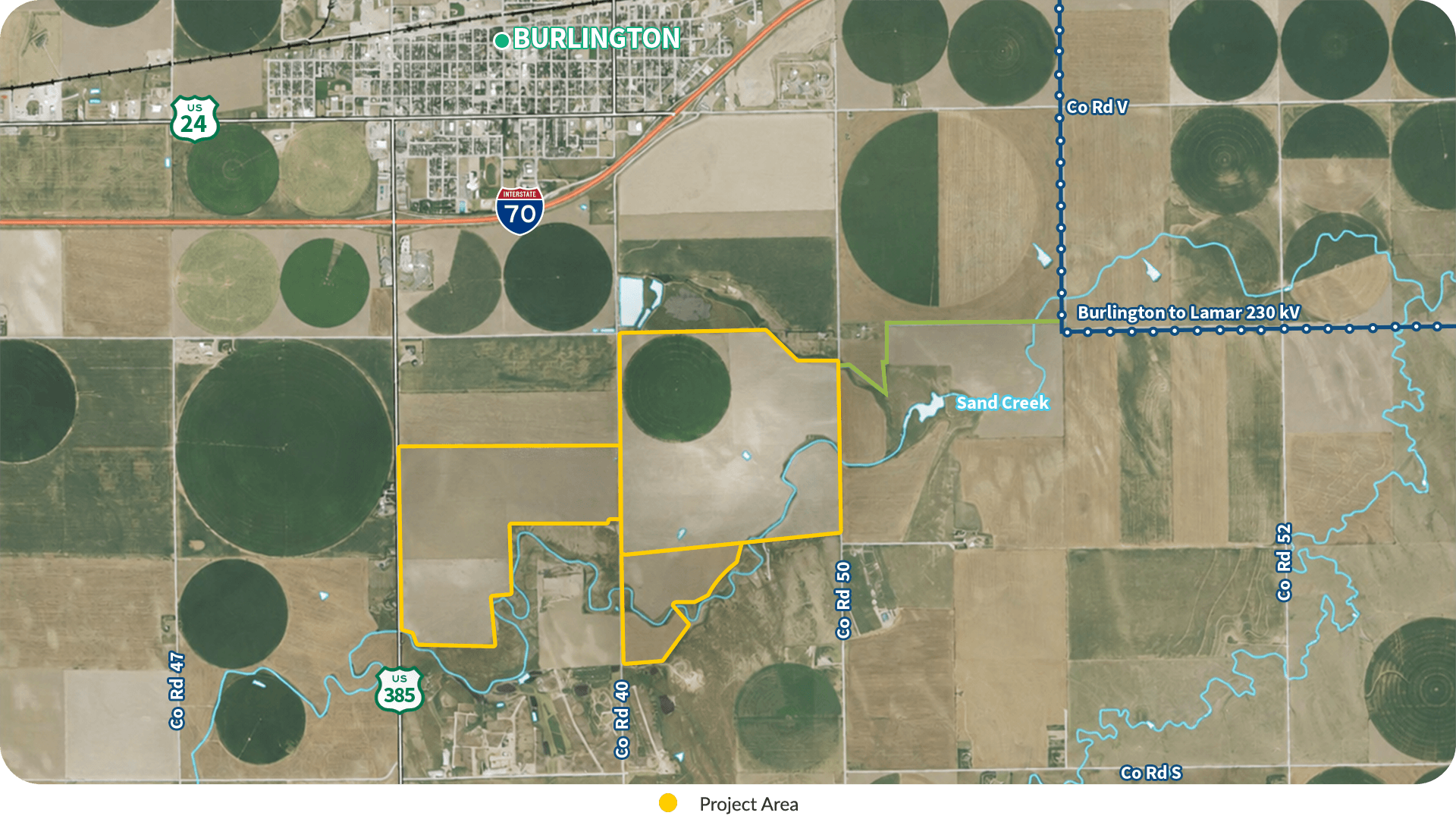
Please note the map above is a graphic representation and may not indicate exact locations.
Preliminary Studies 2024.
Included CIA, Wetlands and Wildlife surveys, Phase I Environmental Site Assessment.
Conceptual Engineering 2026.
Included ALTA land surveys early 2026
Project Engineering and Permitting
Spring 2026 through end of 2027.
Kit Carson Phase I CUP Approved March 2026.
Continued site engineering fall/winter 2026.
Continued site impact studies winter 2026-spring 2027, include visual simulations and glare studies.
Kit Carson Phase II CUP anticiped Spring 2027.
Pre-construction permitting mid 2027-early 2028.
Project Construction
Summer of 2028 through Winter 2029.
A community meeting with local landowners is anticipated for late 2027 to discuss Project updates and seek additional community input.
In the United States, Plenitude’s activities include also the development and operation of photovoltaic and energy storage projects. The company works with local communities, landowners, and stakeholders to develop projects in consultation with local communities, landowners and stakeholders, with the aim of supporting energy needs and local economic activity. Additional company information is available here.
Will this project lower my property value?
A 2025 peer-reviewed study in the Proceedings of the National Academy of Sciences (PNAS) found that utility-scale solar increases agricultural and vacant land values by approximately 19% within a 2-mile radius, driven by expectations of lease income and the significant increase in county tax revenue from the Project’s presence. For any neighbors near the project boundary, the developer is open to discussing setback commitments, vegetative screening, and landscaping buffers.
Will chemicals from the solar panels or batteries leach into the soil or groundwater?
Modern crystalline silicon solar panels contain no liquid chemicals that could leach under normal operating conditions—they are sealed glass and aluminum units. In the event of catastrophic physical damage, trace materials (silicon, aluminum, glass) are not expected to create a material groundwater risk under normal operating conditions. BESS systems contain electrolyte solutions sealed within individual battery cells, within sealed containers, on concrete pads with secondary containment berms. The project will design all BESS areas with secondary containment and stormwater controls in compliance with Colorado CDPHE standards, designed to prevent routine releases, in accordance with applicable Colorado CDPHE requirements.
What happens to the panels and batteries when the project is decommissioned?
The project will be required to post a decommissioning bond—calculated to fully cover removal and site restoration—as a permit condition before construction begins. Crystalline silicon panels are predominantly aluminum, glass, and silicon, which may be recoverable through recycling channels available at the time of decommissioning. Battery modules contain recoverable lithium, cobalt, and other materials; battery recycling infrastructure is expanding rapidly due to EV industry demand. The decommissioning plan, including recycling commitments and bond amounts, will be submitted as part of the permitting application and updated as decommissioning approaches.
Will runoff from the solar site cause flooding or erosion on neighboring properties?
A Stormwater Management Plan (SWMP) and Erosion and Sediment Control Plan (ESCP) will be implemented prior to the commencement of construction. During construction, silt fencing, rock check dams, and temporary vegetation stabilize disturbed areas. At full operation, maintained vegetation between panel rows intercepts and slows rainfall. A site-specific stormwater assessment will evaluate runoff relative to existing land conditions, and the final design will incorporate required controls, because the maintained vegetated cover provides consistent ground infiltration that bare cultivation does not.
Will the solar panels create a blinding glare for neighboring properties, drivers, or pilots?
Modern photovoltaic panels are engineered to absorb sunlight, not reflect it, and carry anti-reflective coatings. Published sources report low reflectance for photovoltaic modules, but the project-specific Glint and Glare Analysis will assess the selected equipment and site layout—less than bare soil, asphalt, or standing water, and dramatically less than glass windows or metal roofs. Single-axis trackers dynamically tilt away from the horizon at sunrise and sunset—the highest-glare periods—further reducing any potential off-site impact. The project can provide a formal Glint and Glare Analysis assessing potential effects on neighboring residences, county roads and flight paths and identifying mitigation where needed.
Will the solar panels or battery storage make noise that affects nearby residents?
Solar panels produce no sound whatsoever. Inverters and transformer equipment generate a low-frequency hum, typically 45–55 dB at close range—comparable to a household refrigerator or HVAC unit—and with sound levels at receptors depending on equipment selection, distance, terrain and background conditions. BESS container cooling fans produce noise comparable to commercial HVAC equipment. The project will comply with Kit Carson County noise standards, and a pre-operational noise study can be conducted and submitted to confirm compliance at the nearest residences.
Construction on this scale will damage county roads. What is the developer’s responsibility?
Plenitude will negotiate a Road Use Agreement with the county before construction begins, including: a pre-construction road condition survey with photographic documentation; designated haul routes that minimize impact on the most vulnerable roads; restrictions on heavy construction traffic during harvest season; and likely a performance bond ensuring all affected roads are restored to pre-construction condition or better.
Will construction create dust problems for neighboring farms and residences?
Dust control is managed through a Dust Control Plan submitted to the county as a permit condition. This includes water trucks on active grading areas, enforced speed limits on unpaved construction roads, wind-event protocols that pause grading during high-wind conditions, and revegetation timelines. The project’s long-term operational footprint may reduce fugitive dust during operations compared with existing cultivated conditions, subject to vegetation establishment and site-specific monitoring, since vegetated cover under and around panels is actively maintained throughout operations. A community liaison with a direct contact number will be designated before construction starts, giving neighbors a clear path to report any concerns.
Can solar panels catch fire, and what happens if they do?
Solar panels themselves have a very low fire risk—they are passive devices with no moving parts or fuel source. DC wiring faults are the most common cause of solar-related electrical incidents, and modern systems use arc-fault circuit interrupters (AFCIs), rapid shutdown systems, and continuous monitoring to detect and isolate faults within seconds. This project will fully comply with NFPA 70 (National Electrical Code), Colorado Fire Code, and all applicable IFC requirements, and will coordinate with the Kit Carson County Fire Department on a site-specific Emergency Response Plan before commissioning.
We’ve heard about the Moss Landing BESS fire in California. Could that happen here?
The January 2025 Moss Landing incident illustrates exactly what current standards are intended to reduce the likelihood and consequences of. That facility used nickel-manganese-cobalt (NMC) battery chemistry inside a retrofitted 1950s-era building without adequate modern ventilation or compartmentalization. The Burlington project will use lithium iron phosphate (LFP) batteries—a substantially more thermally stable chemistry—in a purpose-built outdoor containerized system. The facility will comply fully with NFPA 855 (2023 edition), UL 9540/9540A, and Colorado’s updated January 2026 Fire Code with enhanced BESS standards. The proposed outdoor, containerized configuration differs materially from the Moss Landing facility. Compliance will be confirmed through permitting, equipment certification and the site-specific fire-safety review.
What toxic chemicals are released in a BESS fire, and would residents need to evacuate?
In a thermal runaway event, lithium-ion batteries can release hydrogen fluoride (HF), carbon monoxide, and particulate matter. This is a concern the project takes seriously. However, a March 2025 independent review of 35 BESS incidents from 2012–2024 by Fire & Risk Alliance (commissioned by the American Clean Power Association) found that post-incident environmental monitoring at the incidents reviewed did not identify hazardous concentrations of HF or hydrogen cyanide at site boundaries. Engineered setbacks, container-level compartmentalization (each battery container is individually isolated), automated gas detection and pre-coordinated emergency response with the county fire department all work together to minimize risk to surrounding properties.
How difficult is it to put out a BESS fire, and does the local fire department have the capacity to respond?
Lithium-ion fires are difficult to extinguish with traditional suppression, which is why this project’s design philosophy is prevention-first: continuous 24/7 monitoring, battery management system (BMS) real-time alerts, automated internal fire suppression in each container, and deflagration panels to safely vent pressure. The goal is that any thermal event is contained at the individual container level before requiring active external suppression. Prior to commissioning, the project team will engage directly with Kit Carson County fire departments to assess local capacity, provide site-specific training, contribute to equipment as needed, and co-develop a written Emergency Action Plan. The fire department will have the site plan, chemical inventory, and a 24/7 direct contact before the facility goes live.
How often do BESS fires actually occur? Is this a common problem?
Reported BESS incident rates per deployed capacity have declined in the cited EPRI dataset; the project should provide the dataset, definitions and calculation used. The Electric Power Research Institute (EPRI) global database shows failure rates have dropped over 98% per gigawatt-hour deployed between 2018 and 2024, while total deployed capacity grew from 11 GWh to over 300 GWh globally. The cited source reports 8 U.S. incidents in 2024; this figure should be presented with its incident definition, reporting scope and source date. The risk is not zero, but it is low, declining, and not directly comparable with other local industrial or agricultural fire risks without a consistent methodology and exposure basis—uses already common in Kit Carson County.
Residents have voiced opposition to other solar projects on social media. How is the developer responding to community concerns?
We take these concerns seriously and are not dismissing them. Many of the questions raised in community forums—about roads, fire safety, visual impact, and long-term land use—are legitimate questions that deserve direct, substantive answers, which is the purpose of this document. We commit to holding at least one open community meeting in Burlington before any final BOCC action and maintaining a project website with a plain-language FAQ and direct contact.
If you have any questions, we want to hear from you. Email us at:
