Don’t stop here
There’s much more to discover!

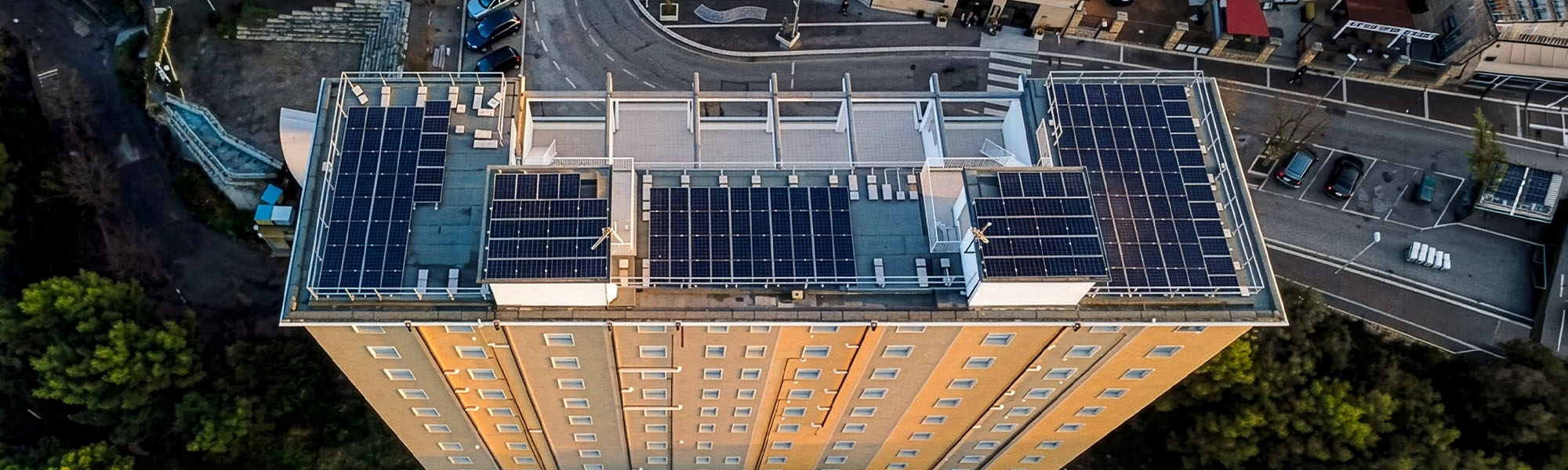
From unused rooftops to energy generation: the project for the So.co.mo. Apartment Building in Montegranaro and the virtual sharing of energy.
Apartment buildings are particularly well suited to energy-sharing models, especially Collective Self-Consumption (CSC). Taking advantage of this opportunity, a dedicated project was launched in Montegranaro, in the province of Fermo, Italy. The So.co.mo. Apartment Building made its rooftop available for the installation of photovoltaic panels, joining “Energia Collettiva”, the solution developed by Plenitude for residential settings of this kind. Following the installation of the system, completed at the end of 2025, the process to establish the Collective Self-Consumption arrangement was finalised, with the configuration becoming operational on 15 April 2026.
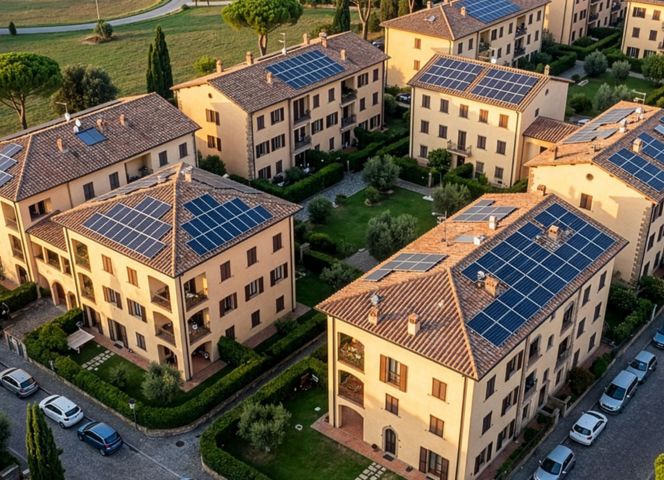
Italian legislation provides for several Renewable Energy Sharing Self-Consumption Configurations (CACER), as explained in our in-depth article (link). Among these, the Collective Self-Consumption (CSC) model allows residents in the same building to virtually share the electricity generated by a common installation.
Through its “Energia Collettiva” solution, Plenitude covers the cost of installing the system and guarantees its maintenance, taking responsibility for its technical management over a 20-year period. At the end of this term, the contract gives the apartment building the option to purchase the infrastructure at a predetermined price.
This arrangement creates tangible benefits for both parties: the building incurs no installation costs, uses part of the energy generated to reduce consumption in common areas and receives the incentive paid by GSE (Gestore dei Servizi Energetici – Italy’s Energy Services Operator) on the amount of energy shared. At the same time, Plenitude recoups its initial investment by selling on the market the energy that is not self-consumed and is fed into the public grid.
Activating a self-consumption configuration requires specific procedures and close support throughout the process. For the So.co.mo. project, Plenitude assisted the building’s property manager in handling the entire administrative process, from preparing the documentation required for grid connection to uploading the relevant data to the GSE online portal.
Furthermore, to ensure the highest safety standards during installation and subsequent technical management, Plenitude also arranged for a permanent rooftop fall-protection system (known in Italy as a “linea vita”) to be installed. This infrastructure allows technicians to work safely and will remain available to the building for any future maintenance work.
Two separate photovoltaic systems have been installed on the roof of the building, which comprises 26 residential units. Each system has an installed capacity of 20 kWp, bringing the total installed capacity to 40 kWp. Both are connected to two dedicated electricity withdrawal points (PODs), used exclusively to supply the building’s common services, such as the lift and lighting.
In operational terms, the infrastructure is expected to generate approximately 41,000 kWh of electricity per year. Of this amount, around 2,000 kWh per year will be used for self-consumption through the building’s PODs, effectively covering the electricity needs of the common areas during the central hours of the day*. The remaining 39,000 kWh per year will be fed into the public electricity grid.
This energy fed into the grid provides the basis for the sharing mechanism: when the approximately 20 participating residents draw electricity from their household supply during the same time slots in which the building’s photovoltaic system is generating and feeding electricity into the grid, they virtually generate a share of the energy that is recorded and incentivised by GSE.
Energy-sharing configurations are particularly well suited to smaller municipalities, where activating a Collective Self-Consumption arrangement in an apartment building can naturally encourage word-of-mouth among residents, helping people gain a practical understanding of these opportunities and supporting their wider adoption across the local area.
Projects like this demonstrate that collective energy sharing in apartment buildings is a practical, scalable solution that can become part of everyday life, transforming unused rooftop space into an active resource for residents.
*An analysis of actual consumption data shows that electricity consumption is virtually zero during daylight hours, corresponding to time band F1.
There’s much more to discover!
Plenitude’s project for Nuova Simplast and the advantages of virtual sharing to overcome the physical constraints of self-generation.
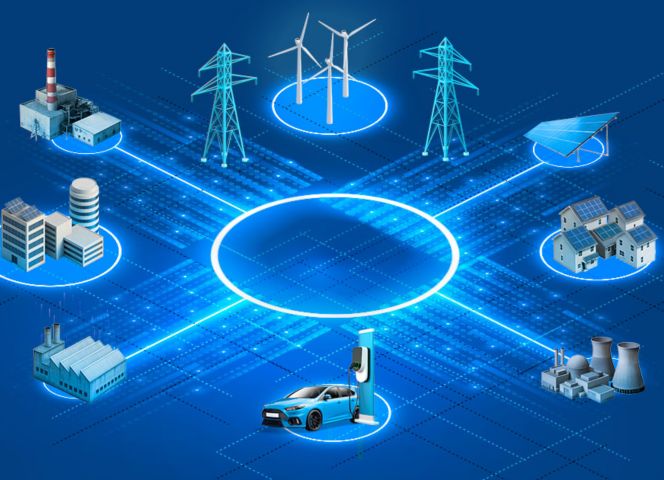
From managing bidirectional flows to integrating renewables, smart grids are the essential infrastructure for energy efficiency, energy communities and smart districts.
Prosumer, smart grid and digital energy: towards a flexible energy system