Don’t stop here
There’s much more to discover!


The contemporary home can take the form of a digital ecosystem in which energy and technology work together through the network infrastructure.
The concept of the “smart home” has historical roots dating back to 1966, when engineer Jim Sutherland installed the first home computer to manage household functions. While in the past development was constrained by wiring infrastructure and communication protocols, today the smart home is based on a network of devices interconnected via the Internet, in line with the Internet of Things paradigm. This evolution has encouraged the spread of integrated solutions. Current systems not only automate certain household functions, but also make it possible to analyse usage data, which can support more informed management of some household functions, depending on the characteristics of the devices, their configuration and how they are used.
To provide certain functions, smart home devices need to communicate with one another and, in some cases, with cloud platforms that serve as environments for collecting, processing and coordinating the data generated by connected appliances. This network enables users, for example, to control their home appliances remotely, set up automations and integrate devices within the same digital ecosystem. Without an adequate network, the use of these tools may be limited.
Fibre optics can provide a suitable technological infrastructure to support these smart home use cases, based on measurable technical characteristics. First and foremost, speed: when FTTH (Fibre To The Home) technology is used, connecting the telecommunications operator’s network directly to the home, the connection can provide high transmission capacity1. This is complemented by low latency, a parameter that can enable rapid response times to commands sent via apps or voice assistants for managing automations2. Fibre also contributes to signal stability, as the fibre section is less susceptible to electromagnetic interference. Finally, it is an infrastructure designed to support the addition of new IoT devices without significantly affecting performance.
In certain scenarios, the network infrastructure can also be one of the enabling factors for digital energy, understood as the use of digital tools to monitor and analyse data. In smart homes, this can often involve the use of sensors and smart meters, which measure consumption and send data to users’ devices. One practical example is the smart thermostat, which does more than turn the boiler on or off: it can set room heating times and adjust the temperature based on whether people are actually present or on their geolocation.
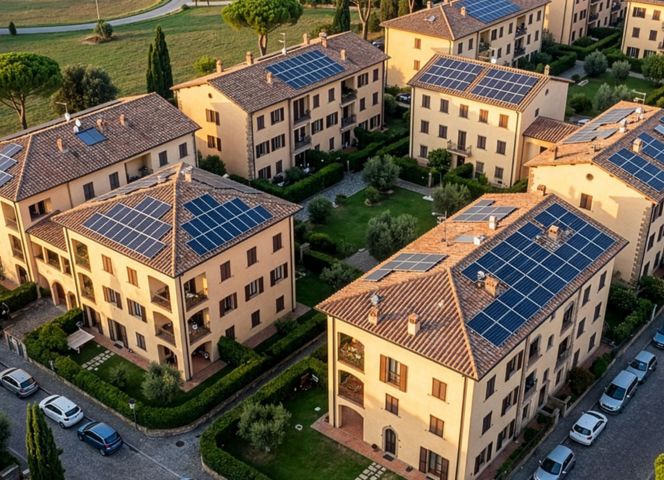
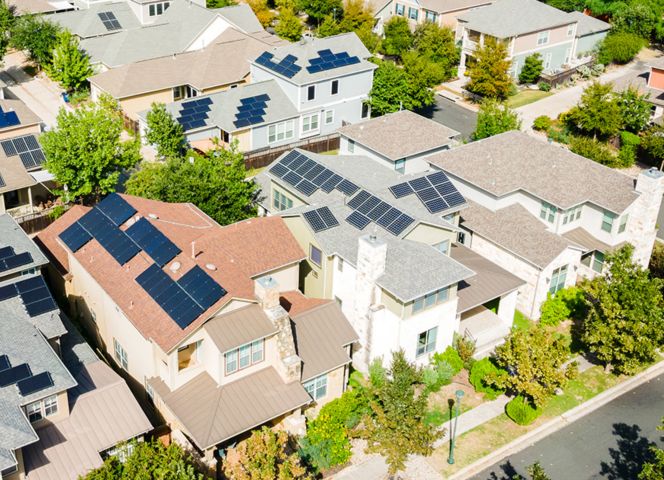
When a smart home also includes systems for the self-generation and self-consumption of energy, this monitoring becomes even more complex and important, as it can make it possible to coordinate energy drawn from the grid with energy supplied by photovoltaic panels or stored in storage systems
The digitalisation of energy within the smart home can help create some of the technical conditions required for energy flexibility, understood as the ability to adjust production and consumption in response to conditions in the electricity system. Monitoring building data can support demand management approaches (Demand Side Management), namely methods for scheduling or adjusting certain electricity uses when compatible devices, control systems, and offers or programmes that enable their use are available. On the demand side, a connected home can make it possible to schedule certain forms of consumption, such as starting home appliances or charging a car, during specific time slots, while taking account of the user’s needs and the signals available. This scheduling can change when energy is used without necessarily reducing total consumption. On the supply side, those with a photovoltaic system and storage systems can manage the energy produced and stored for local use and, in the cases and according to the procedures provided for, for feeding it into the grid. In this context, the home’s digital infrastructure can support the coordination of these functions and, where compatible technologies, vehicles, infrastructure and services are available, integration with electric mobility solutions such as V1G and V2G.
The widespread use of smart metering and digital energy will accompany this process, making it possible to monitor consumption and adjust loads in line with users’ needs and the balance of the electricity grid. In this scenario, the combination of smart devices and connectivity becomes strategically important in supporting the integrated management of household energy.
1Actual performance depends on the service activated, the home network, the modem or router, and the conditions of use.
2The result depends on the entire technology chain, including devices, the home network, cloud platforms and the applications used.
There’s much more to discover!
In 1839, physicist Antoine César Becquerel discovered the photovoltaic effect, but it would take until the end of the century for the first solar cell to become operational.
Prosumer, smart grid and digital energy: towards a flexible energy system
From simple users to active players: here’s how prosumers are transforming the energy system through production, sharing, and flexibility.